
Citizen sells two very different kinds of watch. Eco-Drive models are quartz watches charged by light. The Tsuyosa line is mechanical and winds itself on the wrist. Which one suits you depends on how often you wear a watch and how much you care about accuracy, and this page sets out the differences using Citizen’s own published specifications.

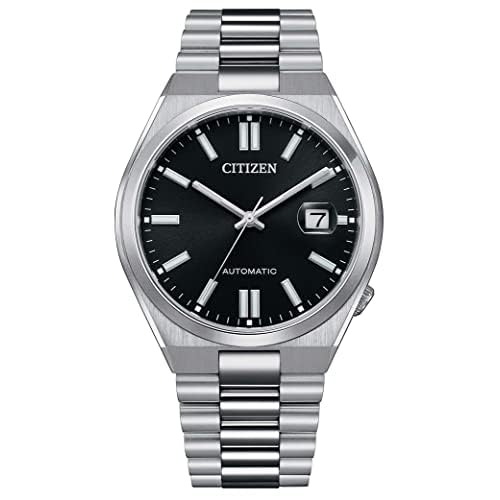


Citizen men’s watches at a glance
| Model | Power | Case | Water resistance |
|---|---|---|---|
| Eco-Drive AW5000-16L | Light, about 240 days per full charge | 42mm steel | 10 bar |
| Tsuyosa NJ0150 | Automatic cal. 8210, 40 hours | 40mm steel | 5 bar |
| Tsuyosa 60 NK0024-54X | Automatic cal. 8310, 60 hours | 40mm steel | 5 bar |
| Promaster Diver BN0150 | Light, cal. E168, 180 days | 44mm steel | 20 bar, ISO 6425 |
Figures come from Citizen’s product pages for the NJ0150 and the BN0150, and from the reviews linked in the table.
Eco-Drive: how the light-powered watches work
An Eco-Drive watch has a solar cell under the dial. Light passes through the dial, the cell turns it into electricity, and a rechargeable cell stores what the movement does not use straight away. Citizen’s Eco-Drive page says any light works, including office lighting and desk lamps, and that a full charge runs a typical model for over six months.
Two behaviours are worth knowing before you buy, because both get mistaken for faults:
- Second hand jumping two seconds at a time. This is the low-charge warning. The watch still keeps correct time, and the hand returns to one-second steps once it has had enough light.
- Hands stopped after time in a drawer. Models with power save stop the hands in the dark to save energy while still tracking the time internally. The hands move to the correct time when light reaches the dial.
Citizen recommends five or six hours of direct sunlight a month for best results. A watch worn under a cuff through an Irish winter gets less light than one worn on a bare wrist in July, so leave it on a windowsill now and then instead of in a drawer.
The technology is older than the name. Citizen released its first light-powered analogue watch, the Crystron Solar Cell, in 1976 and introduced the Eco-Drive name in 1994, according to its technology history. In 2023 it launched calibre E365, which runs for a year on one full charge.
Our AW5000-16L review covers a pilot-style Eco-Drive in detail.
Tsuyosa: Citizen’s automatic watches
The Tsuyosa is a 40mm steel watch with an integrated bracelet, a sapphire crystal and a date window at 3 o’clock. It needs no battery and no light. A rotor winds the mainspring as you move.
There are two generations on sale:
- NJ0150 series, calibre 8210. Citizen lists a 40-hour power reserve, accuracy of ±20 seconds a day, 5 bar water resistance and a weight of 138g on the bracelet. Read the Tsuyosa NJ0150 review.
- Tsuyosa 60 NK0024, calibre 8310. The same idea with a 60-hour reserve, so it survives a weekend off the wrist. Read the Tsuyosa 60 review.
Note the accuracy figure. ±20 seconds a day is normal for an automatic at this level, and an Eco-Drive quartz model rated at ±15 seconds a month is far more accurate. Buy the Tsuyosa because you want a mechanical watch. If accuracy matters most, buy Eco-Drive. Both Tsuyosa models are compared against other brands in our guide to automatic watches for men.
5 bar means the Tsuyosa copes with rain, hand washing and what Citizen labels still-water swimming. It is not a dive watch.
Promaster: the tool watches
Promaster is Citizen’s range for diving, flying and outdoor use. The model most often seen in Ireland is the Eco-Drive Diver, reference BN0150. Citizen’s specification lists a 44mm steel case 12mm thick, a screw-down crown and caseback, a one-way rotating bezel and 20 bar water resistance to the ISO 6425 dive-watch standard. Calibre E168 runs for 180 days on a full charge.
That combination is the appeal. A dive watch that never has its caseback opened for a battery keeps its seals undisturbed for longer. The crystal on the BN0150 is anti-reflective mineral glass, which scratches more easily than the sapphire on a Tsuyosa.
Eco-Drive or automatic: which to choose
| Eco-Drive | Tsuyosa automatic | |
|---|---|---|
| Power source | Any light | Wrist movement or hand winding |
| Published accuracy | ±15 seconds a month | ±20 seconds a day |
| Left unworn | Runs for months on a full charge | Stops after 40 or 60 hours |
| Routine upkeep | No battery changes | Periodic movement service |
Choose Eco-Drive if you rotate between watches or want one to pick up and trust. Choose a Tsuyosa if you will wear it most days and like the idea of a mechanical movement.
Who makes Citizen watches
Citizen traces its history to the Shokosha Watch Research Institute, founded in Tokyo in 1918. Its first pocket watch, finished in 1924, was named “Citizen” by the mayor of Tokyo, and the company took that name in 1930. Citizen’s company history describes it as a manufacture that makes its own components and assembles its own watches.
The group also makes Miyota movements, which are sold to other watch brands, and it owns Bulova. See our Bulova watches for men page for that side of the family.
Warranty and buying Citizen in Ireland
Citizen UK states that its five-year limited warranty covers watches bought in the UK and Ireland from an authorised retailer. That last condition matters when buying online.
- Check who the seller is. A listing on Amazon.ie can be sold by Amazon or by a marketplace seller. If the five-year cover matters to you, ask the seller before ordering whether the watch comes with the Citizen UK and Ireland guarantee booklet.
- Keep proof of purchase. Citizen asks for the completed guarantee booklet and a receipt with any claim.
- Know what is excluded. The warranty covers the movement. Case, crystal, crown, bracelet and strap are not covered.
- Plan for seal checks. Citizen says water-resistant models, Eco-Drive included, should be tested and resealed every two to three years.
Bracelet sizing is the other practical point. Tsuyosa bracelets are integrated into the case, so you cannot swap in a standard strap, and links need removing by a jeweller or with a pin tool.
For Citizen against other brands by budget, see men’s watches under €250 and men’s watches under €500.
Citizen watches: common questions
Does a Citizen Eco-Drive ever need a battery?
It needs no routine battery change. Light keeps the rechargeable cell topped up. That cell is a component like any other and can be replaced by a Citizen service centre if it eventually stops holding charge.
How do I charge an Eco-Drive watch that has stopped?
Put it dial-up in daylight. Citizen says power generation resumes as soon as light reaches the dial. A fully run-down watch needs a long charge before it runs normally, and the charging times for each calibre are in its instruction manual.
Is the Citizen Tsuyosa waterproof?
It is rated to 5 bar. Citizen labels that as suitable for rain and still-water swimming. Use a Promaster diver rated to 20 bar for diving.
Does Citizen make automatic watches?
Yes. The Tsuyosa uses Citizen’s own calibres: the 8210 with a 40-hour reserve and the 8310 with 60 hours.
Are Citizen watches made in Japan?
Citizen is a Japanese company and the Tsuyosa caseback is marked “Japan movement”. Assembly location varies by model, so check the caseback or the listing if it matters to you.
What is the difference between Citizen and Bulova?
Bulova is an American brand founded in New York in 1875 and owned by Citizen. The two ranges are designed and sold separately.
Related guides: see our best solar watches for Eco-Drive against Casio and Seiko solar, and our dive watches under €300 for the Promaster Diver.